

Space for New Chains: Design Research into the Rotterdam Petrochemical Cluster
The Rotterdam petrochemical cluster is one of the largest industrial concentrations in Europe and plays a central role in the Dutch industrial and energy systems. The design research Space for New Chains explores how the petrochemical cluster in the Port of Rotterdam can transition into a circular and climate-neutral chemical cluster. By developing two perspectives we explore the extremes of these possibilities, and identified which spatial qualities are important for the long-term future and where structuring choices need to be made to make use of those qualities.
-
Location
Petrochemical complex in the port of Rotterdam
Year
2024-2025
-
Energy transition
-
Regional strategies
-
College van Rijksbouwmeester en Rijksadviseurs
-
Duong Bui, Jenny Hu, Georgia Kokolaki, Rens Wijnakker
Perspectives
In recent years, a number of studies have been conducted that make statements about the future of industry in the Netherlands and, in line with this, the port of Rotterdam and the petrochemical cluster. All studies assume a climate-neutral society, net 0 CO2 emissions, and a circular economy.
The explorations have in common that the bandwidth of possible futures for the port complex is very large: from a significant shrinkage of the chemical cluster to maintaining and expanding the international position of the cluster.
In order to get a grip on these bandwidths, two perspectives have been developed that explore the future of the petrochemical industry. The first perspective assumes a stagnation or shrinkage of the chemical industry as a result of limited demand, the second perspective assumes a growing demand and continued international ties.
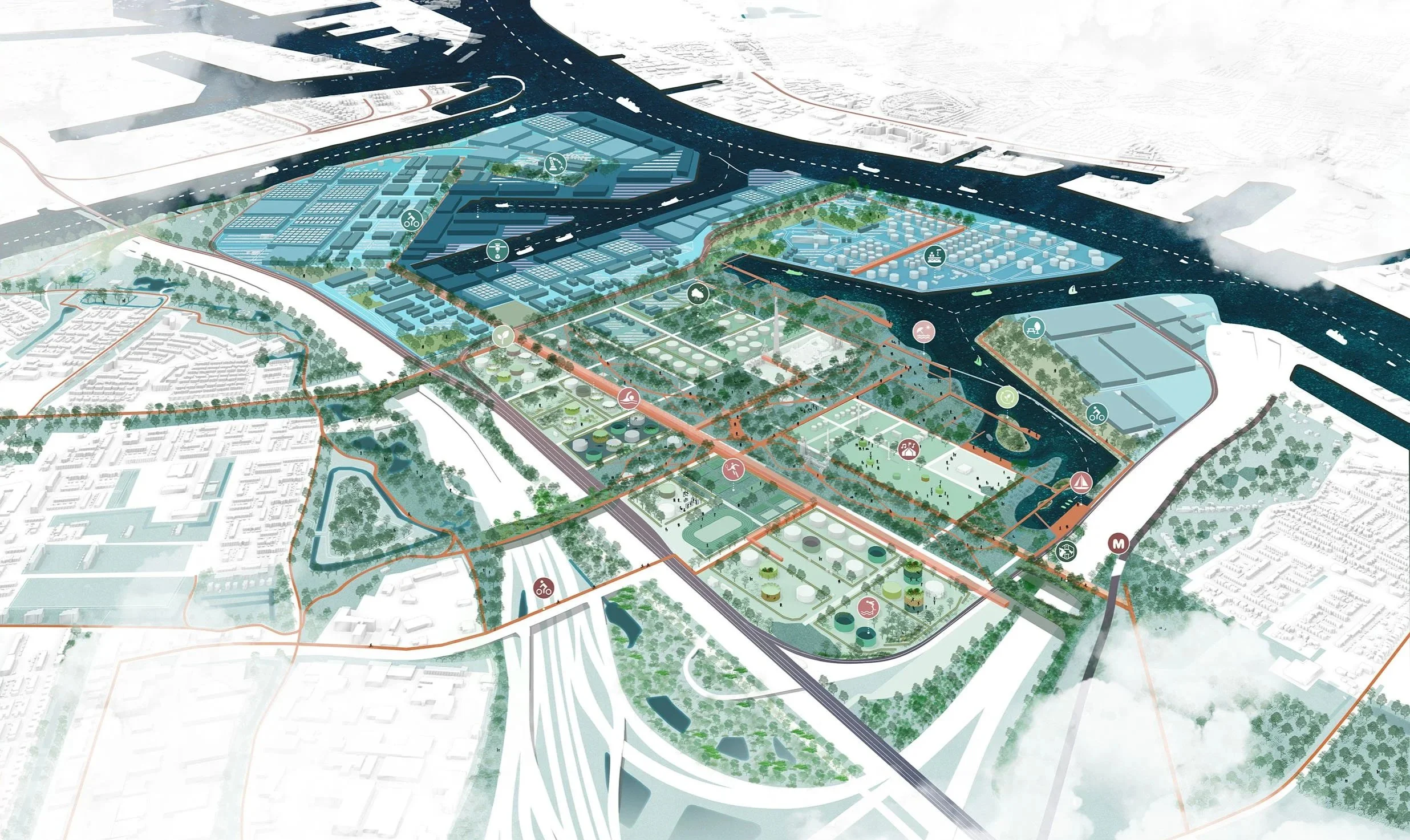
Perspective 1: Conversion and Phase-Out
Transition of Vondelingenplaat: Ample space for the circular economy on Vondelingenplaat, with room for urban livability by linking a tidal park, urban green structures, and new functions in former industrial sites.
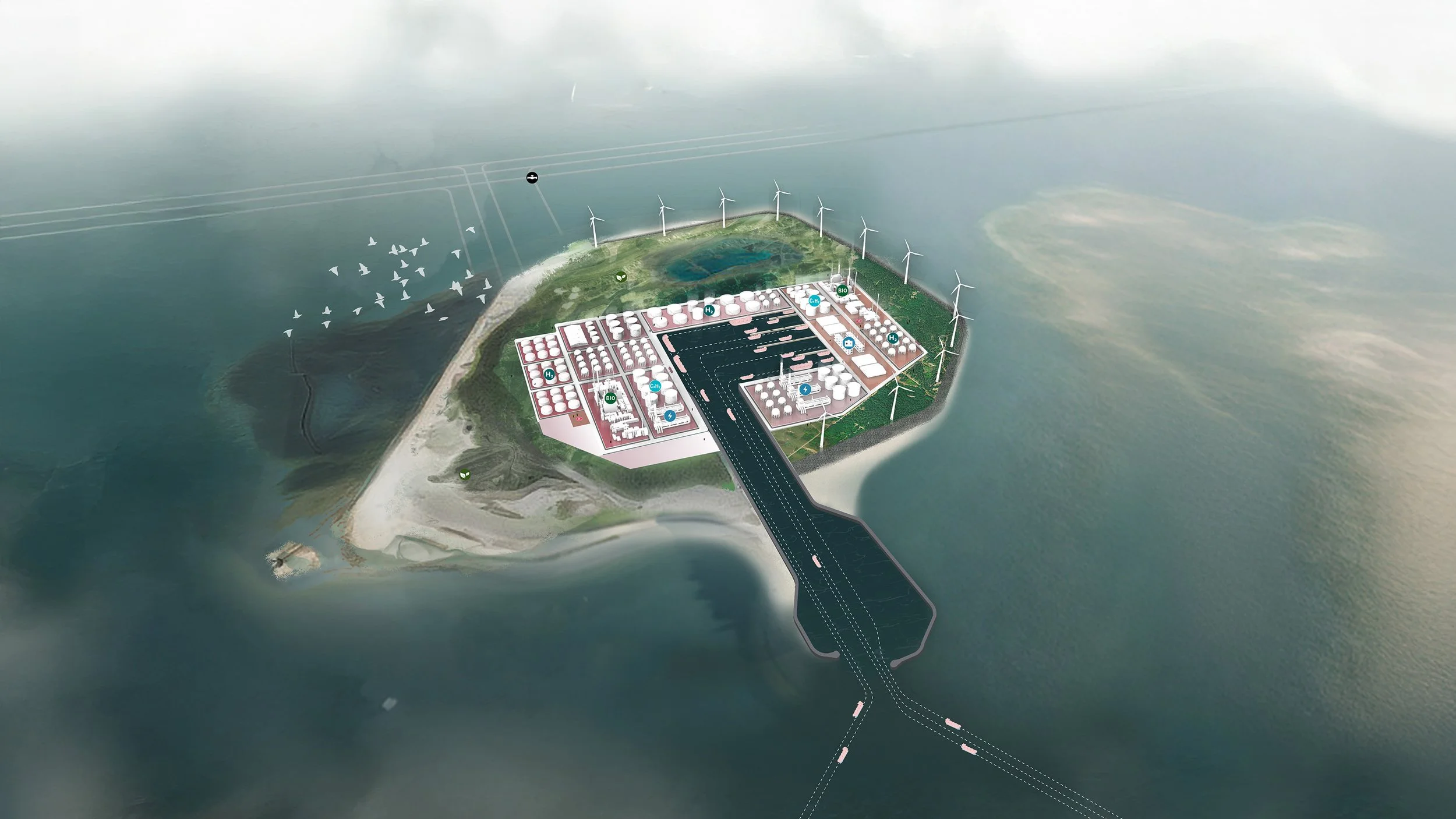
Perspective 2: Conversion and Expansion
New industrial island: A new island, located approximately 10 km west of the Maasvlakte outside the Natura 2000 area, would serve as a hub for heavy process industries such as biorefining, ammonia cracking, and electrolysis, connected to Rotterdam and Antwerp via pipelines and cables.
Adaptation Pathways
A number of developments are expected and underway that will have a far-reaching impact on the functioning of the port, but also offer management options that can be anticipated. Many of these issues will only play a role in the second half of this century, but cast their shadows ahead because they require anticipation for adaptation and the use of opportunities. These are processes that can sometimes take decades.
This is partly due to the uncertainties regarding the speed of certain developments. Climate change is happening faster and is having a faster effect than the current forecasts for the flood protection programme are based on. Deindustrialisation is also currently accelerating in the hinterland of the port, which could lead to the disappearance of coal and oil terminals in the short term. If Dutch industry wants to maintain its international top position with a wide range of services, and continue to play a key role in a climate-neutral and circular economy, additional space is probably needed.
You can find more information about the report here.
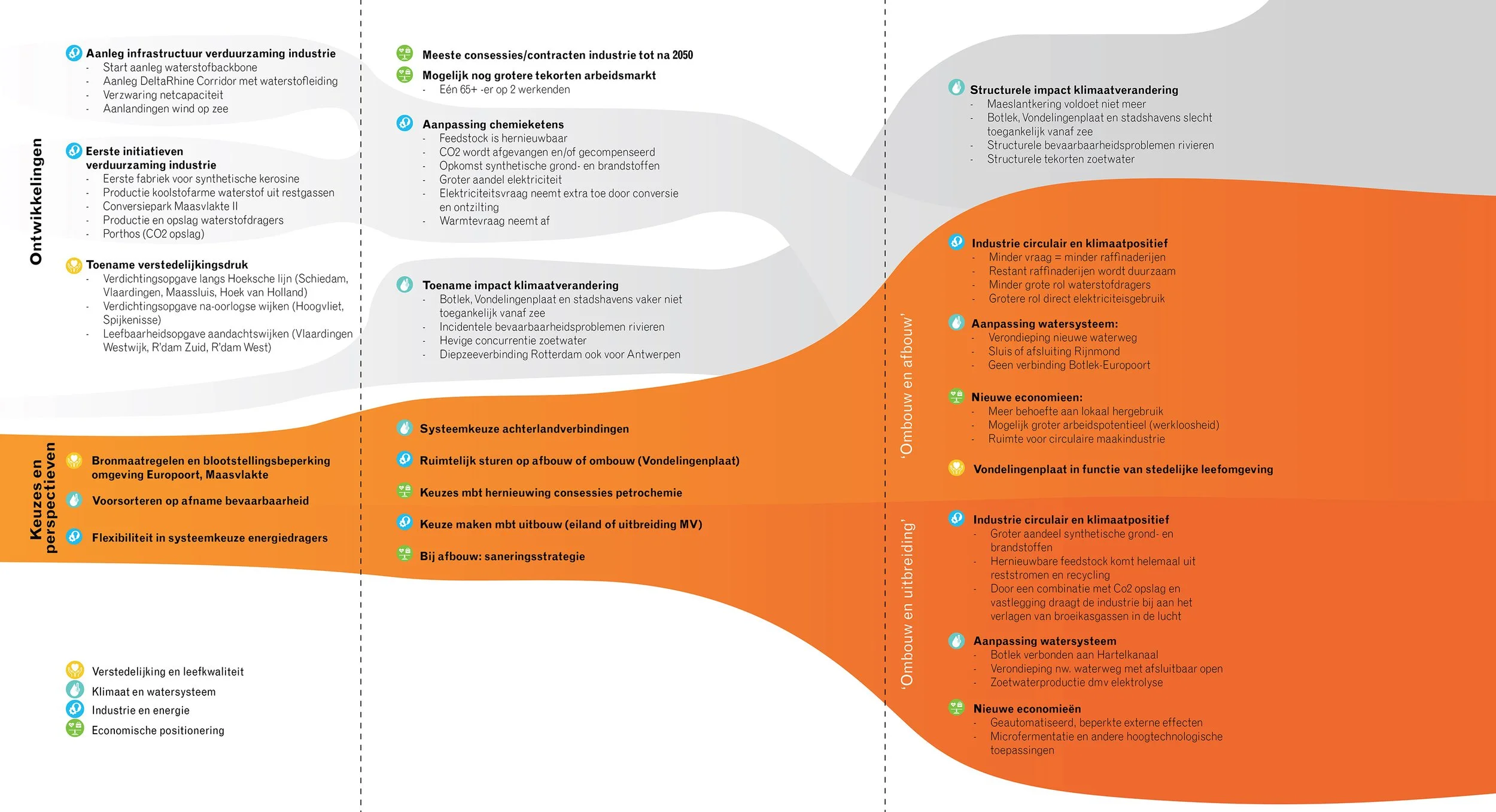
The petrochemical complex in Rotterdam is by definition not future-proof, because it is based on fossil raw materials. Although part of the sector can continue to exist with compensation of emissions, a large part will transform to alternative raw materials such as biomass, residual flows and synthetic fuels. Spatially, the challenge lies in the transition: first, extra space is needed for the future system, while the existing system remains operational. This space only becomes available later in the process.
In addition to the challenges within the sector itself, climate change and urbanisation play an important role in the future sustainability of the petrochemical industry in Rotterdam. Parts of the port are becoming less accessible by water and are facing an increased risk of flooding due to rising sea levels and greater fluctuations in river discharge. Urbanisation is putting pressure on the port due to environmental and safety risks that an industrial environment entails in a densely populated urban area. The future of the petrochemical complex will be determined by the interplay between port, city and water, and the priorities set within this. The key question in triage is therefore: is there future value for green chemistry at this location?
Explorations into possible futures for the port complex reveal a wide range of scenarios, from significant downsizing of the chemical cluster to maintaining or even expanding its international role.
“Spatially, the challenge lies in the transition: first, extra space is needed for the future system, while the existing system remains operational. This space only becomes available later.”
Analysis
The Rotterdam petrochemical cluster is one of the largest industrial concentrations in Europe and plays a central role in the Dutch industrial and energy systems. The cluster consists of five large refineries and dozens of chemical companies that together are responsible for a significant contribution to GDP and employment. In addition, the region is a hub for the import and export of fossil fuels and chemical products, with strong connections to Antwerpen and the Ruhr area via pipelines, shipping, road transport and railways.
The challenges that lie ahead for the transition to a circular and climate-neutral economy raise the question of what the future prospects are for the chemical sector and its position in the Rotterdam region. After all, it is built on a 20th century reality of ample availability of fossil fuels, low energy prices, limited environmental requirements and ample availability of labour potential. The cluster is under pressure from international climate goals, rising energy prices and changing legislation and regulations. The geopolitical context is also putting pressure on the industry. The production of the Rotterdam industry has been shrinking for a year and a half now. Is this a harbinger of a collapse, as we know from the mining region, or is the shrinkage temporary and is there actually room for the energy system of the future?