
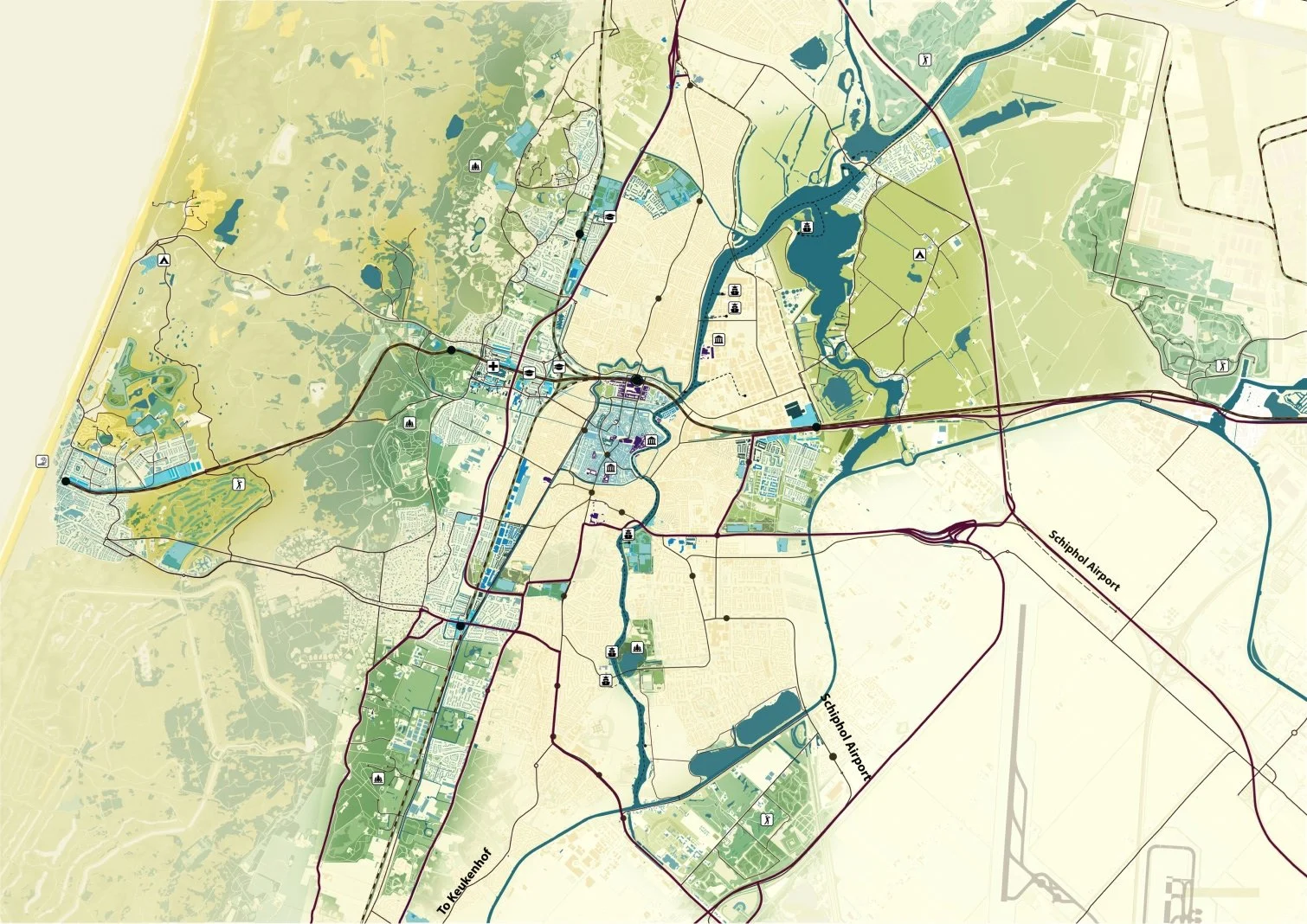
Perspectives Haarlem
Haarlem’s success within the Metropolitan Region Amsterdam has intensified pressure on its housing market and mobility system. As more Amsterdam-based workers move to Haarlem, the imbalance between living and working grows. In response to this, we have developed two strategic perspectives: Spoor and Spaarne. Rather than choosing one direction, the study makes the trade-offs explicit: reach versus proximity, metropolitan integration versus local completeness.
-
Location
Haarlem, NetherlandsYear
2020 -
Municipality of Haarlem
-
Design directors
Olv Klijn, Eric FrijtersProject manager
Rens WijnakkerTeam members
Lisanne Corpel
Yingzi Wang
Duong Bui
Yana Markos
Haarlem’s attractiveness has brought prosperity — but also pressure. More residents are commuting daily to Amsterdam and Schiphol, while housing prices increasingly put teachers, nurses, and police officers out of reach. Infrastructure investments reinforce these commuter patterns, even as tourism and internationalisation reshape the city centre. Social inequalities are becoming spatially embedded. Without strategic choices, Haarlem risks becoming a residential satellite: a comfortable, yet increasingly one-sided “sleeping city” of the metropolis.
FABRICations carried out an in-depth, interdisciplinary investigation and drew two distinct future perspectives to show how choices might affect the future development of the city, and to help shape the dialogue on Haarlem’s future.

Perspective 1: Spoor
Haarlem as a Cosmopolitan Subcentre
Spoor refers to the long-existing railway connection between Haarlem and Amsterdam, and focuses on metropolitan integration. Haarlem strengthens its regional connections and develops around high-quality public transport nodes, with densification concentrated near stations and along mobility corridors. The Waarderpolder transforms into a mixed-use innovation district, while high-end housing and knowledge-based industries cluster around transport hubs. Accessibility becomes the primary economic driver, and the city centre increasingly specialises and internationalises. Energy production is organised regionally to protect urban quality, positioning Haarlem as an attractive residential environment within the MRA.
Perspective 2: Spaarne
Haarlem as an Inclusive and Complete City
Spaarne refers to the river that runs through Haarlem, which is responsible for the establishment of the city of Haarlem, and emphasises internal balance. Rather than expanding outward, Haarlem invests in proximity: housing is diversified across income groups, and employment is distributed throughout the city. Neighbourhood centres anchor social life, while densification occurs in a fine-grained, context-sensitive manner within existing districts. Living and working are rebalanced, with cycling and pedestrian networks structuring mobility. Energy transition initiatives are visible within the city, and green-blue infrastructure enhances climate resilience. Community-building and neighbourhood vitality remain central.

Conclusion
Spoor and Spaarne are not ready-made solutions, but strategic lenses, each revealing different implications for mobility, housing policy, economic positioning, tourism strategy, energy transition, and social cohesion. The study does not advocate one scenario over the other; instead, it clarifies what is at stake. Haarlem stands at a crossroads between reach and proximity, between metropolitan integration and local completeness.

